As of April 2026, the EES (Entry/Exit System) is fully operational across all Schengen area airports. The new biometric border control—designed to enhance security and automate the traceability of non-EU travelers—has introduced a concrete challenge that Italian airports are currently navigating: existing physical security portals were not originally designed to handle the processing times and passenger throughput required by this new framework.
The long queues recorded at major hubs in the months following its implementation speak for themselves. The bottleneck is not technological in the purely digital sense: readers, scanners, and software platforms are operating effectively. The issue is physical: access points, sorting corridors, and exit gates are unable to sustain the new operational structure.
For airport authority managers—or those designing terminal expansions, renovations, or new terminal facilities—this is the precise moment when access control infrastructure decisions become a strategic imperative, rather than merely operational considerations.
Airport Access Control Is Not Solely a Security Challenge
In an industrial plant or a banking institution, an access control system has one primary objective: keeping unauthorized individuals out. In an airport environment, this feature becomes significantly more complex: thousands of passengers must move seamlessly every day through physical gates that must simultaneously remain highly secure, fast, fully integrable with boarding pass readers or biometric systems, and strictly compliant with direction of travel requirements.
In practice, airport operators face multiple overlapping challenges:
- Throughput Speed: A security portal that slows movement by even a few seconds compounds into queue delays of dozens of minutes during peak hours.
- Unidirectional Control: Certain areas—especially arrivals exits—must ensure that no individual can travel in reverse. This is not an optional feature; it is a mandatory safety requirement enforced by international public entities and safety regulations.
- Integration with Readers: Physical gates must offer full compatibility with readers for boarding passes, passports, or staff credentials. The physical barrier executes commands reliably thousands of times per day based on upstream validation.
- Accessibility: Every access line must incorporate appropriate passageways for passengers with reduced mobility (PRM), without compromising the overall security perimeter of the zone.
- Mechanical Durability: Airports operate 24/7. Access control gates must withstand years of continuous, intensive duty cycles without performance degradation.
Critical Airport Zones: Selecting the Right Solution for Each Area
An airport is not a uniform environment. Each zone presents distinct functional requirements, and selecting an inadequate gate type—even for a single section—can compromise overall terminal operations.
Landside Zones (Pre-Security Checkpoints): These are public access terminal areas, including entrances, check-in halls, and retail zones. Flow is bidirectional and volume is extremely high. Here, security gates primarily serve to segregate staff-only corridors, manage specialized access, and secure secondary staff entryways.
Airside Zones (Post-Security Checkpoints): Dedicated exclusively to departing passengers and authorized airport staff. Here, physical separation must be absolute: individuals in the airside sector cannot re-enter landside areas without undergoing security screening again. Portals must integrate with boarding pass validation systems and instantly block any wrong-way entry attempt.
Passenger Exit Corridors (Arrivals): Representing one of the most critical security bottlenecks in the airport environment, the corridor separating the arrivals zone from the public terminal must guarantee strictly one-way exit movement. Reverse entry is non-negotiable and unacceptable, as it would allow unauthorized access into airside areas by bypassing all security checkpoints.
Technical and Operational Areas: Including tarmac access, baggage handling facilities, technical rooms, and boarding gates. Restricted exclusively to credentialed personnel, often with multi-tier access privileges. Physical gates must interface with the airport’s central access control management system and maintain fully traceable audit logs.
SAIMA Solutions for the Aviation Industry
SAIMA Sicurezza serves the aviation sector with a product portfolio engineered specifically to address high-traffic airport demands: motorized gates and security portals combining high transit speed, proven mechanical reliability, and seamless integration with existing credential reading and identity verification technologies.
The Swing Gate 425 Motorized Gate is specifically designed for airport infrastructure. Featuring high-speed swing glass leaves, it ensures high passenger throughput even during peak operational loads and integrates seamlessly with boarding pass scanners, biometric verification devices, and RFID readers. It serves as the primary benchmark for boarding area and airside access control.
For zones demanding controlled access paired with high passenger volume, the Pass 256/297 Motorized Gate was engineered specifically for high-density public mass transit systems. Its architectural design supports rapid throughput while maintaining strict single-passage control.
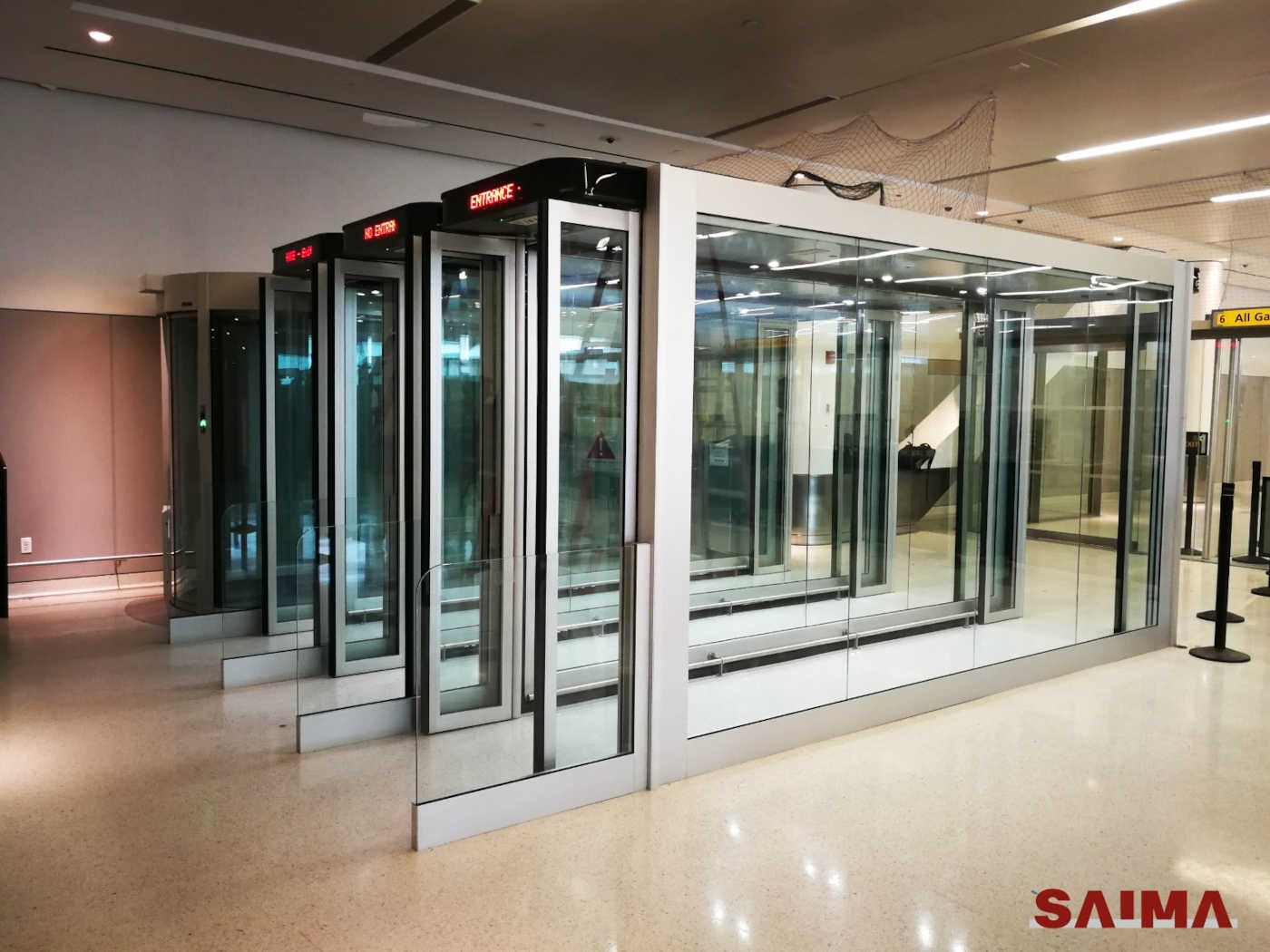
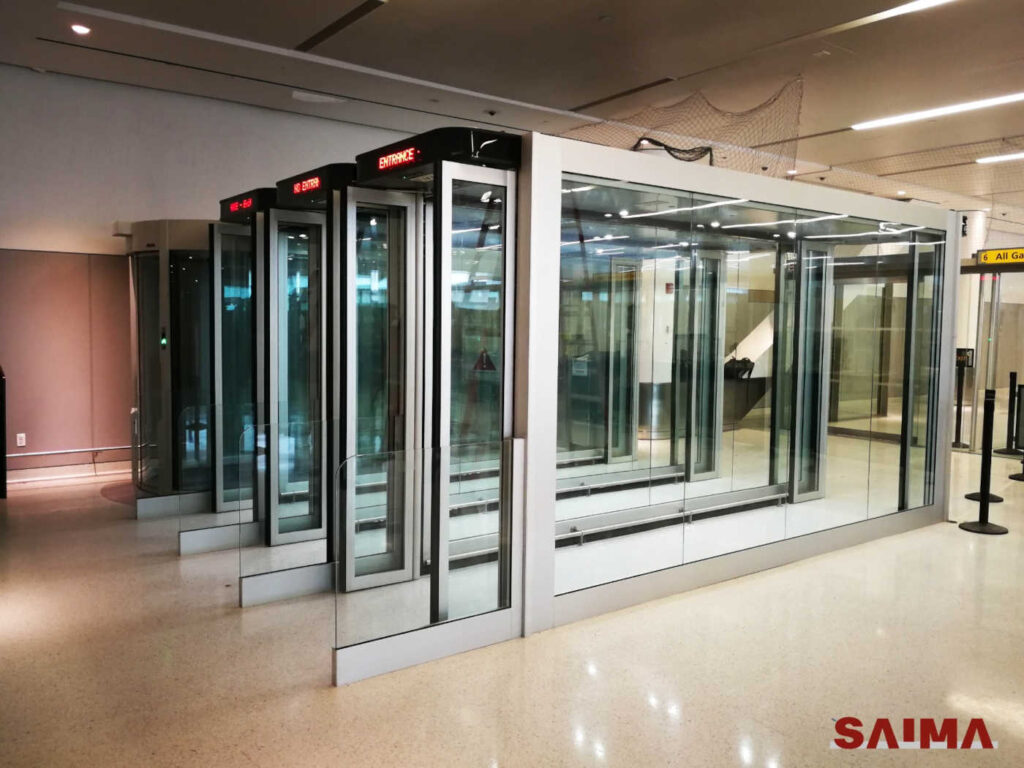
The ABC Gate represents SAIMA’s dedicated security interlocking door (security portal) for airports: a compensation airlock interlock that guarantees single-passenger throughput while physically preventing any wrong-way movement. It interfaces with all leading document-reading and biometric platforms, offering the most comprehensive answer for high-security airport checkpoints where burglar-resistant or vandal-resistant structures are essential.
For arrivals exit corridors—arguably the most sensitive point in passenger traffic management—SAIMA developed the Exit Lane Corridor: a robust one-way exit system that physically prevents unauthorized entry back into airside zones while maintaining smooth outbound passenger flow.
Completing the airport portfolio, the Swing Gate 330 Motorized Gate and Pass 107 Light Motorized Gate provide versatile access management for landside areas and employee checkpoints. The PR 449 compact motorized gate flag shutter rounds out the product range for spatial constraints where access control enforcement remains mandatory.
Designing for the Future: System Integration and Scalability
The ongoing transformation across international airports extends far beyond the implementation of the EES framework. Over the coming years, airport authorities and public entities are required to modernize physical infrastructure to accommodate expanding passenger traffic, comply with increasingly stringent international security standards, and deliver an elevated passenger experience that balances speed with uncompromised safety.
Within this framework, selecting physical access control portals and security interlocking doors is a strategic long-term investment. Equipment installed today must readily integrate with future technologies—including evolving document verification protocols, centralized access control management, and real-time security monitoring software. Future-proof integration capability is not an optional feature; it is a fundamental design requirement.
SAIMA systems for airport applications are built upon this exact philosophy: robust structural hardware, field-tested heavy-duty mechanics, and open interface protocols supporting integration with all major market-leading access control and document reader systems.