On February 10, 2026, the Ministry of the Interior Decree of December 24, 2025 came into force, redefining technical standards for safety, accessibility, and operation of sports facilities intended to host UEFA Euro 2032. A regulation that does not only affect the five stadiums that Italy will submit for UEFA selection by October 2026, but establishes a new benchmark standard for the entire sector: in fact, the provisions apply both to newly constructed facilities and to existing ones, including projects already approved prior to the date of entry into force.
For those who manage, design or finance a sports facility, the message is clear: access control security can no longer be postponed. And it involves much more than just signage or entrance gates.
What the decree provides for access control
The decree introduces a comprehensive framework of technical requirements that directly addresses public entry and egress systems, security area management, spectator control by sector and emergency management.
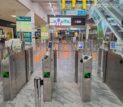
Among the most relevant directives from an infrastructural standpoint, the decree specifies the presence of at least one camera per turnstile, capable of capturing the faces of spectators at the time of entry — ideally with a synchronization mechanism between ticket scanning and photo acquisition. This means that turnstiles can no longer be mere mechanical barriers: they must be integratable systems designed to receive and transmit real-time data.
The regulation also requires structuring facilities into distinct, independently managed sectors, with access systems that allow effective flow separation and a rapid response in the event of critical situations. Emergency management requires a dedicated operations center, staffed during events, connected to the access control systems and law enforcement authorities.
The real challenge: managing tens of thousands of people without bottlenecks
Anyone experienced in managing major sporting events knows that the most complex problem is not keeping out unauthorized individuals, but swiftly letting in those who have the right to enter. A 50,000-seat stadium that needs to be filled in 45 minutes requires a throughput capacity that few access control systems can deliver without bottlenecks.
This demands careful design of access points: how many turnstiles, of what type, in which configuration, and with what integration into ticketing and surveillance systems. A wrong choice is paid for not in terms of abstract security, but in endless entrance queues, crowd tension, and the risk of unregulated access during peak crowd surges.
A multi-layered system: from perimeter fencing to seating
Access control security in a stadium does not end at the entrance turnstiles. It is a multi-tiered system that extends from outer perimeter fencing down to internal sector management:
- Outer perimeter and pre-filtering areas. The first line of control takes place before spectators even reach the turnstiles. Motorized gates in pre-access areas regulate incoming flows, prevent dangerous crowd density, and enable screening operations before the crowd reaches the internal structures.
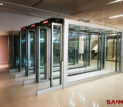
- Sector entrance turnstiles. The core of the system. Full-height turnstiles are the standard solution for high-traffic sports venues: they physically prevent climbing over, ensure single-person passage, and withstand the mechanical stress of a moving crowd during peak hours. SAIMA Sicurezza has been designing sports facility turnstiles for decades: the TR 128 was specifically designed for stadiums and arenas, featuring a galvanized steel structure and a four-sector stainless steel rotor. The TR 129 — installed in major stadiums worldwide — offers a double-rotor configuration for high throughput with the highest level of control. The TR 121 S and TR 121 D complete the range with architectures suitable for venues of various sizes.
- Internal sector management. Once inside, the separation between sectors — away fans, home fans, grandstands, VIP — must be maintained using systems that prevent unauthorized movement. Motorized speed gates and sector pass gates enable dynamic management of internal spaces, essential during evacuation or critical events.
- Integration with surveillance and ticketing. As required by the decree, access systems must integrate seamlessly with surveillance cameras, ticket validation readers, and event management platforms. All SAIMA products for sports facilities are designed for integration with electronic access control systems, badge readers, biometrics, and RS485/RS232 interfaces.
Not just major stadiums: the scope is expanding
The Euro 2032 decree directly targets a limited number of venues, but the regulatory landscape and market expectations are evolving across the entire industry. Arenas, Olympic swimming pools, velodromes, multi-purpose sports centers: even outside Serie A and major stadiums, the demand for structured access control systems is steadily growing.
SAIMA Sicurezza operates internationally within this sector — the New Wembley Stadium in London is among its flagship references — and brings this expertise to smaller-scale contexts, where the challenge is not managing 70,000 spectators, but ensuring a reliable, scalable system compliant with current regulations even with tighter budgets and space constraints.
Are you designing or upgrading your sports facility’s access control system?
The SAIMA Sicurezza team is available to analyze your venue’s specific needs and propose the most suitable solution — from entrance turnstiles to integration with surveillance systems.
Discover SAIMA solutions for Sports Facilities | Request a quote